BIOcean5D aims to understand how marine life changes across space, time and human impact. Achieving this requires collecting an unprecedented volume and diversity of marine data, combining new observations with historical information, and then integrating these heterogeneous datasets to transform them into knowledge that can support science, conservation, policy and decision-making.
CEPHALOPOD (Comprehensive Ensemble Pipeline for Habitat modelling Across Large-scale Ocean Pelagic Observation Datasets) operates at this interface between data and knowledge.
The idea
The AtlantECO project1 brought together diverse observations of marine ecosystems, resulting in a standardised, well-documented dataset with consistent metadata. This revealed a clear next step: the need to integrate this data across sources, types and sampling methods to identify global patterns and reveal insights beyond what any single dataset can provide. “The ocean is a highly connected habitat and this global perspective is essential for effective conservation and informed policy and decision-making,” explains Meike Vogt, senior scientist at ETH Zurich and co-lead of BIOcean5D’s work dedicated to building a digital foundation to explore marine biodiversity.
CEPHALOPOD is the resulting solution: a unified framework that integrates heterogeneous marine data, applies standardised advanced modelling approaches and comprehensively assesses model quality and projection uncertainty to produce comparable and reusable outputs.
From data to models
Marine species distribution modelling (SDM) connects observations of organisms (such as abundance, biomass and community composition) with environmental data (such as temperature, salinity and currents) to predict where organisms live now, help explain why they occur where they do and predict where they might next appear.
Although widely used in terrestrial ecology, until recently, the application of SDM in marine environments has been challenging due to the lack of geo-referenced information on who lives where and with whom. This is now rapidly changing. Over the past decade, the volume of marine ecosystem data has increased exponentially, while new approaches – such as environmental DNA (eDNA) and meta-omics – have expanded the diversity of observations. At the same time, growing efforts to standardise data collection and metadata, together with increasing requirements from funding agencies for FAIR (Findable, Accessible, Interoperable and Reusable) data, have contributed to the growth of international repositories such as the Ocean Biodiversity Information System (OBIS) and the Global Biodiversity Information Facility (GBIF). “There is now not only more marine data, but datasets that are more consistent, interoperable and comparable, and therefore easier to integrate,” explains Meike.
While the increase in data greatly improves model reliability, CEPHALOPOD further builds on this opportunity by providing a consistent assessment of confidence in model outputs. In September 2023, a BIOcean5D species distribution modelling workshop brought together experts from across Europe working at the forefront of SDM research and representing a broad range of approaches and disciplines. Together, workshop participants reached a consensus on how marine SDMs should be evaluated and their uncertainty assessed. “CEPHALOPOD incorporates this community-approved set of quality indicators – that we believe represents a state-of-the-art approach – to rigorously evaluate model performance and quantify uncertainty in model outputs,” says Meike.
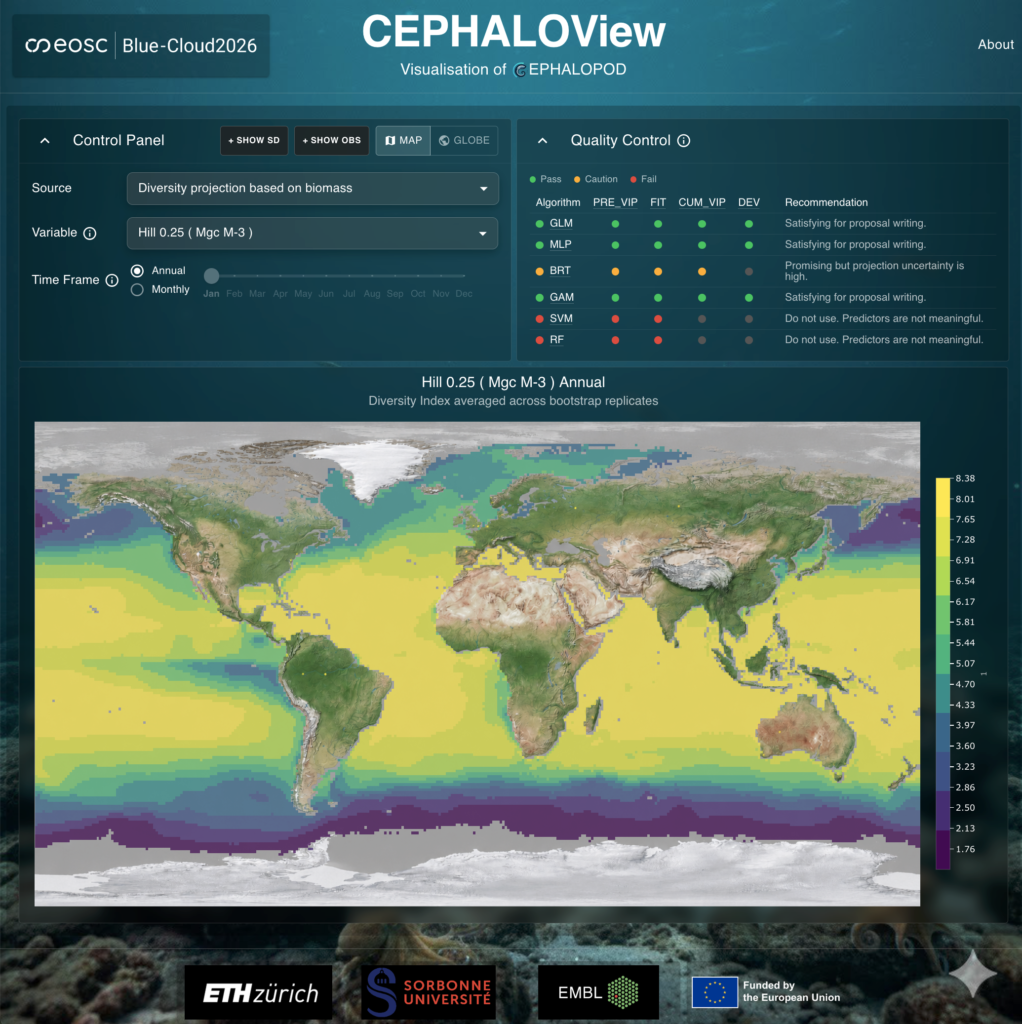 Screenshot of CEPHALOView, the data visualisation application developed to facilitate the accessible presentation of CEPHALOPOD results: https://cephaloview.ethz.ch.
In addition to data, the development and deployment of CEPHALOPOD have also benefited from recent major advances in machine learning, computing power and cloud infrastructure. “From the first prototype developed during a Blue-Cloud2 hackathon, CEPHALOPOD has since evolved into its current version and is deployed through the cloud-computing infrastructure provided by the Blue-Cloud 20263 project,” explains Alexandre Schickele, former postdoctoral researcher at ETH Zurich. “This accessibility – meaning that users don’t need access to local supercomputing facilities to run simulations – is central to the CEPHALOPOD vision of democratising access to marine data, modelling and computational infrastructure. It enables the approach to be opened to a much wider community, including, for example, PhD students and researchers in the Global South.”
CEPHALOPOD – set to be further developed within the EOSC-Marine project as an integral part of the European Digital Twin Ocean (DTO) – demonstrates what can be achieved through international, transdisciplinary collaboration. “Collaboration across projects has brought together multidisciplinary expertise, technological resources, data and ideas to transform a bold idea into reality,” says Meike. “These synergies couldn’t have been achieved by a single project or research group and demonstrate how collaboration can open new perspectives on what can be achieved in marine science.”
From models to knowledge
The diversity of data that CEPHALOPOD can integrate enables a wide range of applications: from scientific studies of the biodiversity and biogeography of marine plankton, to supporting policy-makers, NGOs and environmental agencies in areas including climate impact assessments, conservation planning, marine protected area design and ocean health assessments. The framework could also benefit blue industries seeking, for example, to map the distribution of commercially valuable genes or enzymes. Its outputs could also further support education and training, from university courses and summer schools to public engagement and the visualisation of marine habitats in museums. To facilitate the accessible presentation of CEPHALOPOD results, the team has also developed CEPHALOView, a data visualisation application.
The next version of CEPHALOPOD is already under development. The framework has been designed to access any relevant FAIR dataset and work is underway to integrate data more directly from resources such as EMBL-EBI’s MGnify genomics repository. “Making data from the TREC expedition available through FAIR repositories would enable models to be refined in coastal regions and Exclusive Economic Zones (EEZs), where the majority of national marine policy is focused,” notes Alexandre. Additional objectives include incorporating climate projections under different carbon-emission scenarios, improving depth resolution and increasing the spatiotemporal resolution of environmental predictors. A further goal is to translate the open-source code into an official R package, broadening access and supporting wider adoption of the framework.
The value of CEPHALOPOD, however, ultimately lies in what this integrated global view of the ocean reveals. In our next article, we dive into the first insights revealed by bringing together different ways of observing marine biodiversity.