The Atlantic bluefin tuna is a partially migratory species: after spawning in the Mediterranean, many of the adults migrate vast distances to remote feeding areas, including the mid-Atlantic and northern European waters (e.g., the North and Norwegian Seas). Some adults, however, appear to remain in the Mediterranean year-round. These two kinds of behaviour correspond to two different contingents of the population: migratory and non-migratory.
This species has attracted particular attention in Denmark following its recent return after a dramatic collapse in the 1960s, when the migratory contingent to northern Europe nearly disappeared. This decline had significant ecological consequences for local food webs, as well as economic impacts on regional fisheries. Although the return of the Atlantic bluefin tuna has been linked to major conservation efforts, the ecological drivers governing long-distance migration remain poorly understood. More broadly, this case also highlights the strong interconnectedness between distant marine regions, where ecological changes in one area can have far-reaching effects across the species’ range.
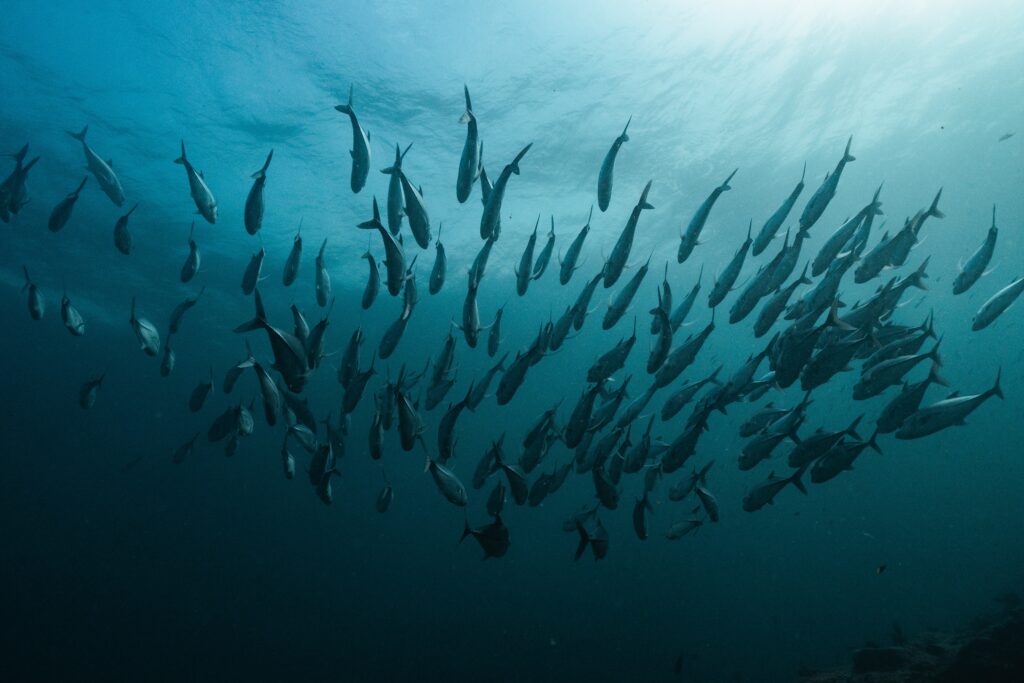 Credit: Kogia / Marla-Tomorug
New insights into these dynamics are emerging from the work of Thøger Engelund Knudsen, a BIOcean5D PhD student at DTU Aqua, the National Institute of Aquatic Resources at the Technical University of Denmark. “My research focuses on the development of mathematical models that describe the emergence, persistence and evolution of migratory routes in fish populations such as the Atlantic bluefin tuna,” he explains. “These models are built on the premise that migration is regulated by group formation and social learning.” This represents a significant advance: although individual interactions, environmental constraints and social dynamics have been suggested as key drivers of migration in seasonally migratory species, they are rarely integrated within a unified modelling framework.
“We divide the annual life cycle of these species into three phases: feeding, spawning and school formation,” continues Thøger. “During the school formation phase, which might occur at the breeding grounds, knowledge of migratory routes held by knowledgeable or experienced migrators could be transmitted to less knowledgeable or more inexperienced migrators through social interactions.” Random encounters between individuals or groups can lead to one adopting the migratory decision of another, resulting from the merging of schools. This process may be central to the persistence of migration strategies, as social learning enables the continuous transfer of knowledge within the population and across generations. Knowledge gained this way may also be a faster and more efficient way of discovering new habitats than by random swimming and searching.
Despite its potential importance, however, this mechanism remains little understood. The newly developed model thus represents an important first step towards capturing these dynamics. Insights provided by the model include the identification of critical thresholds in social learning that determine whether migratory routes are successfully maintained. It also reveals conditions under which small changes can trigger abrupt shifts in population behaviour, including the sudden collapse of migration strategies – findings that are consistent with historical observations.
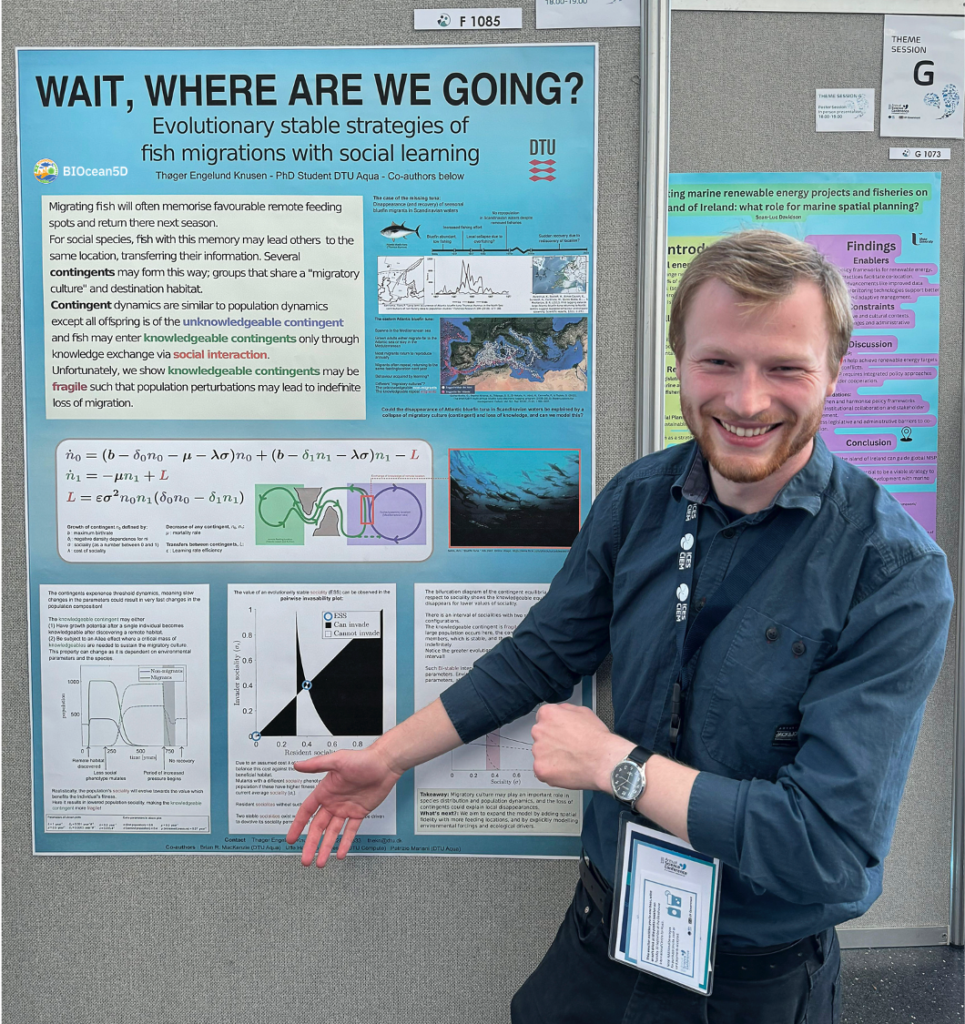 The research was presented by Thøger Engelund Knudsen at the ICES Annual Science Conference 2024.
More broadly, the developed framework provides a foundation for future research on migratory fish species. “It advances our ability to understand the dynamics of such populations, assess the impact of environmental and anthropogenic pressures on migratory contingents and thus improve predictions of changes in migration patterns,” explains Thøger. By identifying key environmental and human-driven factors capable of disrupting migration, the model also offers valuable perspectives for conservation and ecosystem management.
This research is particularly timely given the unprecedented pressures facing the world’s oceans, including overfishing, pollution, habitat destruction and climate change. It contributes to BIOcean5D’s mission to improve our understanding of the impacts of human activity on marine biodiversity and ecosystem health through the development of new bioindicators and high-resolution models. By integrating past and present data, BIOcean5D aims to better predict future biodiversity changes under different scenarios, to ultimately support more effective conservation strategies.
“Being part of this large-scale, multidisciplinary initiative has greatly broadened my expertise, allowing me to expand my background in applied mathematics and modelling to include ecology, oceanography, fisheries science and biology,” says Thøger. “Moving forward, I hope to further develop this modelling framework within BIOcean5D and continue working on modelling social migration dynamics, a field with potential, or in a related area of theoretical marine ecology.”