CEPHALOPOD (Comprehensive Ensemble Pipeline for Habitat modelling Across Large-scale Ocean Pelagic Observation Datasets) brings diverse data and modelling approaches into a unified framework. The research carried out by Alexandre Schickele, former postdoctoral researcher1 at ETH Zurich and first author of the publication describing the framework, has followed a similar path: from individual to unified, and across organisms, observation methods and modelling approaches.
From individual to unified
“During my PhD and postdoctoral research, I used habitat modelling to understand how marine biodiversity is distributed in relation to the environment, working across a wide range of organisms, observation types and datasets: from marine fish occurrence data, then unicellular plankton using relative abundance from metagenomic data, followed by phytoplankton and zooplankton biomass,” says Alexandre.
Individually, each of these projects required the development of a modelling pipeline adapted to the specific taxon, type of data, ecological metric and scientific question. Together, they provided the foundation for CEPHALOPOD, bringing data and approaches previously developed separately into a unified framework.
But combining fundamentally different datasets and modelling approaches introduced a major challenge: designing a standardised approach – across scientific, theoretical and technical perspectives – while preserving the ecological information that makes each dataset unique.
This challenge is also one of the key strengths of CEPHALOPOD. Rather than simply combining models, the framework provides a reproducible way to integrate information and identify coherent patterns across very different types and sources of observations, while also providing an estimate of the uncertainty associated with the resulting projections.
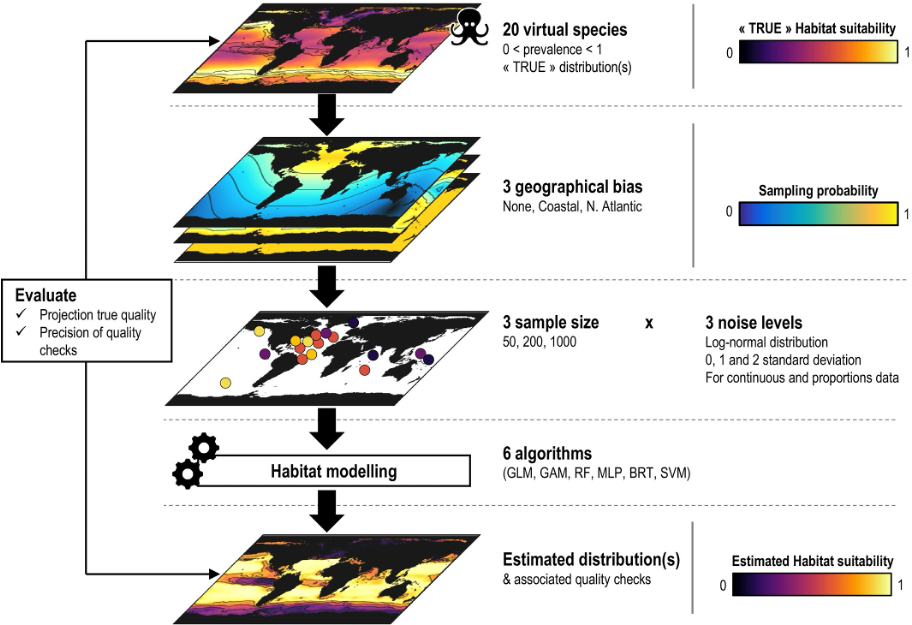 Synthetic diagram of the CEPHALOPOD framework testing on virtual species. Credit: Figure 2 from Alexandre Schickele, et al., (2025). CEPHALOPOD, a package to standardize marine habitat-modelling practices and enhance inter-comparability across biological observations. Methods in Ecology and Evolution, 16, 1126–1135.
A global picture
“Using CEPHALOPOD, we’ve been able, for example, to project global surface-ocean plankton biodiversity from presence-only observations in GBIF (Global Biodiversity Information Facility) and compare these projections with estimates based on metagenomic information collected across Tara Ocean expeditions,” explains Alexandre.
This approach has already revealed unexpected insights. “We’ve found that very different ways of measuring plankton diversity tell a surprisingly consistent story.” Across more than 330,000 observations, a clear global pattern emerged: plankton diversity generally increases towards the tropics, with particularly diverse communities found in nutrient-poor tropical ocean gyres and in fast-flowing western boundary currents.
Each measurement contributes
Different types of observations, however, have revealed important regional differences. “Simply counting the number of species present, for example, suggests that eastern boundary upwelling regions are highly diverse,” says Alexandre. “When we further consider which species dominate these communities – using abundance, biomass or genomic observations – these regions appear less exceptional. This illustrates that no single method of plankton observation can capture the full picture of diversity. Each provides a complementary dimension.”
Alexandre continues: “We also found that some of the most important drivers of plankton diversity – including temperature, primary production and ocean transport – can be observed from satellites.” Satellite observations thus hold the potential to map and monitor different aspects of plankton diversity across the global ocean, alongside measurements collected directly at sea. Combining these complementary sources of information could enable the investigation of biodiversity across regions and timescales beyond what is possible through ship-based sampling alone.
From knowledge to action
Together, these findings show that different ways of observing marine biodiversity are not simply interchangeable: each reveals a different part of the picture. “CEPHALOPOD enables us to understand where different observation methods agree and where they differ,” explains Alexandre. “These insights can be used to improve the design of observing systems, highlight where additional data is required, improve models of ocean ecosystems and ultimately support more effective conservation and better-informed policy and decision-making”.