Marine acoustic monitoring provides a non-invasive, continuous and high-resolution approach for studying marine environments, revealing biodiversity, species presence, behaviours and interactions over long periods. Until recently, however, underwater acoustic studies focused on individual species rather than entire communities. This is now rapidly changing as the central role of sound in species behaviour and ecosystem functioning is increasingly recognised, together with the potential of acoustic monitoring to reveal valuable ecological information. Technological advances and lower equipment costs have also made acoustic monitoring more accessible, enabling deployments across a wider range of habitats and geographic regions.
Within the framework of BIOcean5D and TREC, marine ecoacoustics is being used to fill biodiversity knowledge gaps about the soundscapes of European marine forests, including kelp forests and Zostera meadows in the Atlantic and Posidonia meadows in the Mediterranean. “These studies provide not only an unprecedented description of acoustic communities in these habitats but also reveal how they are shaped by environmental variability – a relationship that has remained largely undocumented up until now,” explains Marine Ethève, PhD student at CEFREM (Université Perpignan Via Domitia, France).
One study focused on a tidal European kelp forest near Roscoff, France. “The area supports extensive kelp forests with exceptional biodiversity,” explains Marine. “And thanks to close collaboration with the Roscoff Biological Station, we received expert guidance on selecting acoustic monitoring deployment sites and access to more than a century of documented observations of local flora and fauna.”
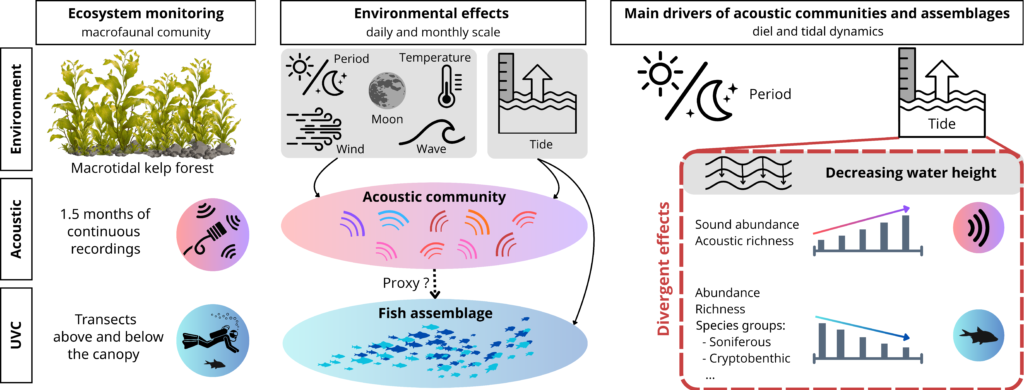 Graphical abstract from Marine Ethève, et al., 2026. Diel and tidal rhythms drive fish acoustic communities in a European kelp forest. BMC Ecology and Evolution, Vol. 26, 47. DOI: 10.1186/s12862-026-02521-z.
During the TREC expedition, continuous passive acoustic recordings were collected using a hydrophone, suspended one metre above the seafloor, between 25 July and 14 September 2023. To investigate the influence of environmental variables on acoustic activity, hourly measurements of temperature, light, wind speed and direction, wave and water height were also collected using in situ sensors and various data sources. Underwater visual surveys from four kelp forest sites around Roscoff complemented the data thanks to the POCOROCH (POissons et Céphalopodes Côtiers des milieux ROcheux et des Herbiers de la façade Atlantique-Manche) monitoring programme, which has been running since 2016.
Together, these datasets revealed that diel and tidal cycles are the primary drivers of acoustic activity, diversity and acoustic community composition. “As expected, acoustic activity and diversity peaked at dusk, dawn and during the night, consistent with the behaviour of many nocturnal fish species and previous observations from other marine habitats,” notes Marine. “We were surprised, though, to find that although visual surveys recorded higher fish abundance and diversity at higher water levels, sound richness and acoustic activity increased during lower water levels. This may reflect increased behavioural interactions as fish become concentrated within a smaller habitat volume.”
Acoustic activity was also found to increase during low tide and calmer sea conditions. “Although we had no prior expectations about how fish taxonomic diversity and abundance would vary with the tide, we were surprised to observe an inverse relationship between acoustic and taxonomic diversity and abundance,” says Marine. “It’s possible that sound production reflects behavioural interactions rather than fish abundance alone and that sound diversity at night does not necessarily reflect fish diversity during daytime.”
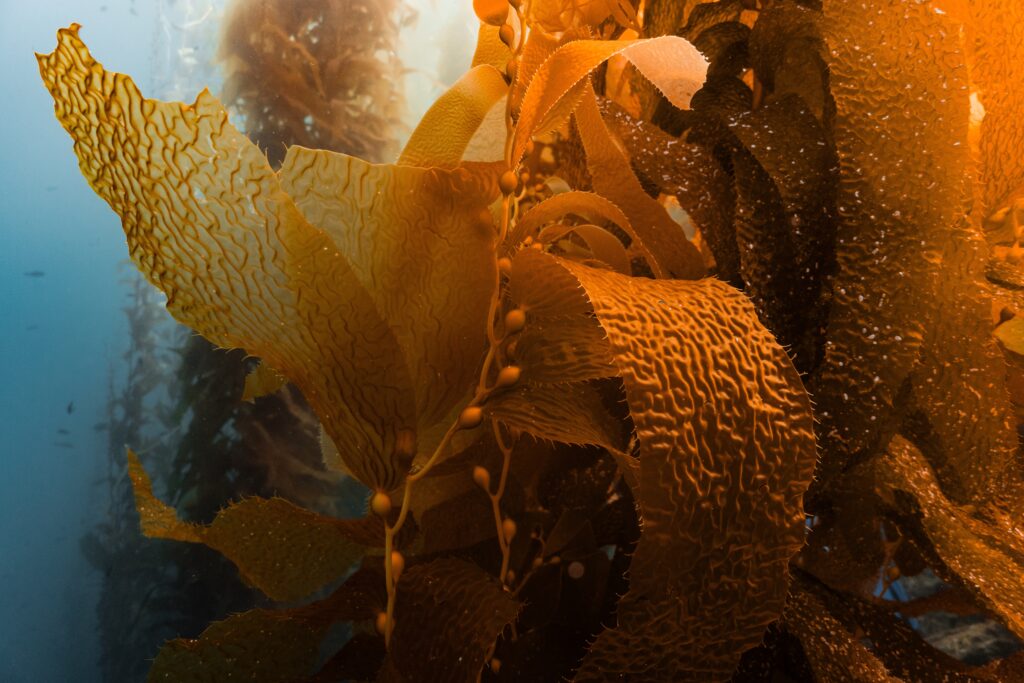 Kelp forests. Credit: Kogia / Marla Tomorug.
Diving further into the results revealed that although 26 distinct sound types were detected, visual surveys recorded only 19 fish species. The authors suggest several possible explanations: “Firstly, a single species can produce multiple sound types associated with different behaviours. It’s also possible that some visually observed species were not detected acoustically. And a few of the recorded sound types were likely produced by invertebrates rather than fish.”
Indeed, of the 19 fish species observed, only six are currently known to produce sounds, while the acoustic capabilities of the remaining species are unknown. “Although sound production has been described for more than 1,200 fish species, this represents only around 4% of known fish diversity,” Marine points out. “Many soniferous (sound-producing) species remain to be discovered, and some species currently classified as non-soniferous may actually produce sounds that have not yet been documented.”
Processing the large volumes of ecoacoustic data generated remains a significant challenge. “Identifying sounds is relatively straightforward when the recorded sound can be matched, using signal processing, to a documented sound in a reference database of emitting species and associated behaviours in a habitat,” explains Marine. “It’s much more difficult though in understudied habitats, where many sounds remain unassigned.”
Although automated detection and artificial intelligence offer considerable potential, they require large, annotated training datasets. “We have developed automated detectors for abundant sounds with known emitting species, as well as a standardised classification system for unidentified sounds based on their acoustic characteristics,” explains Marine. “We are now working towards developing automated detectors for unknown sound types.” Further improving species identification and comparisons between studies requires shared, standardised reference libraries for both identified and unidentified sound types.
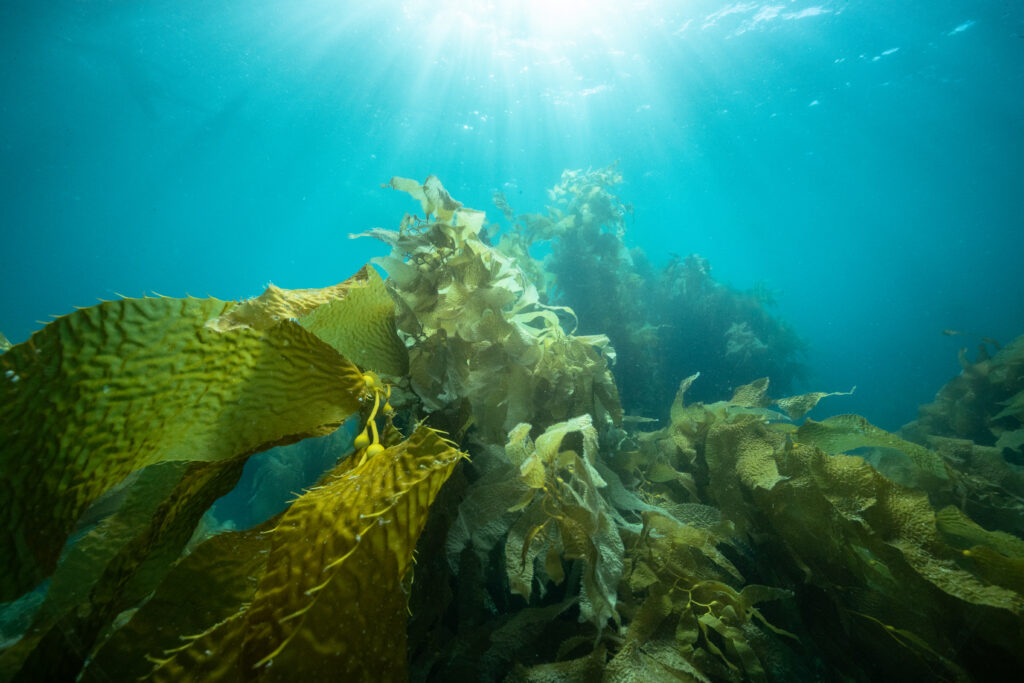 Kelp forests. Credit: Kogia / Karim Iliya.
Alongside contributing to the development of these reference libraries and classification systems, Marine is also preparing two further scientific publications. One investigates the acoustic biogeography of European marine forests by comparing acoustic communities across three habitat types and investigating the geographical factors underlying their differences. The second explores the acoustic niche hypothesis, analysing the temporal structure of acoustic communities in Zostera and Posidonia meadows and the sound characteristics that shape this structure.
Since discovering ecoacoustics during a Master’s in Marine Biology and Ecology, Marine has developed expertise in fish ecoacoustics, large-scale data processing, sound classification, statistical analysis and multidisciplinary collaboration throughout her PhD. Working within BIOcean5D and TREC has provided access to unique datasets, multidisciplinary expertise and collaborations with researchers from diverse scientific backgrounds, enabling acoustic data to be combined with environmental measurements, eDNA, studies of model species and other biological datasets. “This integrated approach provides a far more comprehensive understanding of ecosystem functioning,” she says. “I hope to continue working in ecoacoustics and contributing to marine ecosystem research and conservation.”