Developed by Noan Le Bescot of SeaLabX within the framework of Plankton Planet and the Tara Ocean Foundation, the Curiosity microscope is a powerful yet accessible tool. Compact, affordable and user-friendly, it enables the extraordinary diversity of microscopic life found in aquatic ecosystems to be observed, making an otherwise invisible world accessible to everyone.
Supporting Outreach and Engagement
During the TREC – Tara Europa expedition (2023-24), public engagement activities were organised for local communities at key stops along the route, through a collective effort involving BIOcean5D, the Tara Ocean Foundation and a network of local partners. Curiosity microscopes were provided to local organisations with strong outreach programmes to help strengthen and expand hands-on educational activities.
Bringing the Invisible into Classrooms
Curiosity microscopes, together with teacher training workshops and a suite of educational resources, have also been distributed to secondary schools across Europe, through collaboration between BIOcean5D, EMBL, Plankton Planet and the Tara Ocean Foundation. This initiative empowers teachers to bring the fascinating microscopic life of our oceans, rivers and lakes into the classroom, enabling students to discover the hidden biodiversity of aquatic ecosystems.
The first training workshop took place at EMBL Heidelberg (Germany) in March 2024, followed by EMBL Grenoble (France) in October 2024, a workshop hosted by CusMiBio at the Università degli Studi di Milano (Italy) in June 2025 and a final training session organised at ICM-CSIC in Barcelona (Spain) in July 2025.
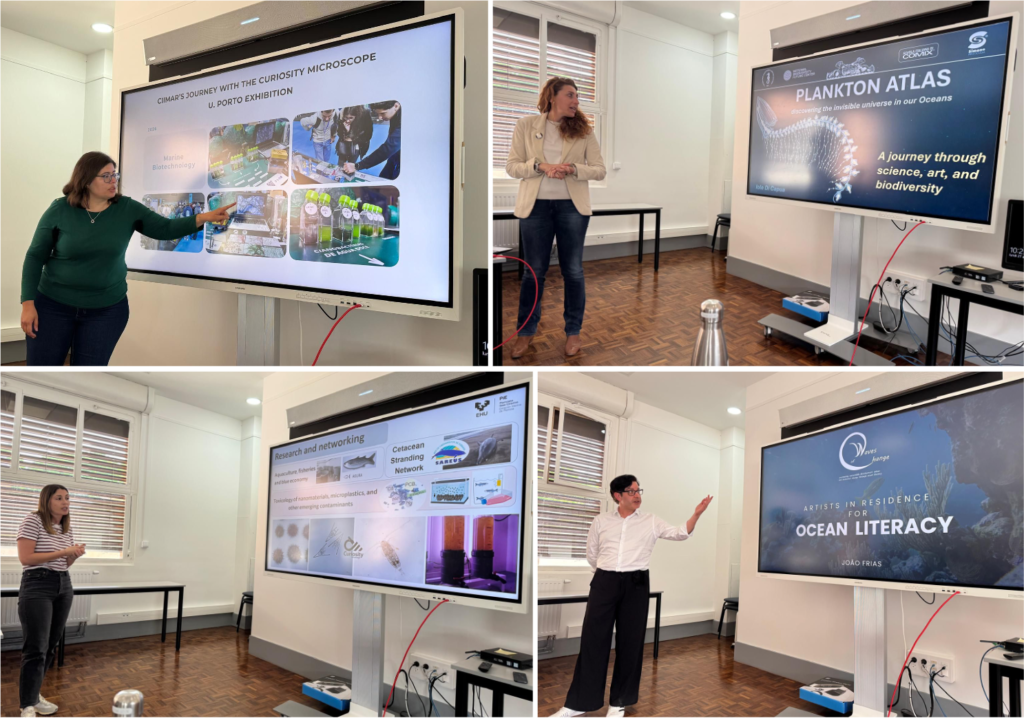 Marta Correia (CIIMAR), Iole Di Capua (SZN), Bilbao Castellanos and Nerea Garcia-Velasco (EHU) and João Frias (Marine and Freshwater Research Centre, ATU Galway City) shared their experiences and showcased how the Curiosity microscopes distributed by BIOcean5D have been used in their research, education and public engagement initiatives. Credit: Noan Le Bescot.
Connecting the Curiosity Network
The Plankton Planet Curiosity-Scopy workshop, held on 27-28 April 2026 at the Muséum National d’Histoire Naturelle (MNHN) in Paris, brought these Curiosity microscope recipients together from across Europe.
The first day of the workshop opened with participants sharing their experiences and showcasing how the Curiosity microscope has been integrated into a wide range of research, education, public engagement and artistic initiatives. Participants presented ongoing and future projects, demonstrating the many ways in which the microscope supports scientific discovery and public awareness of aquatic biodiversity.
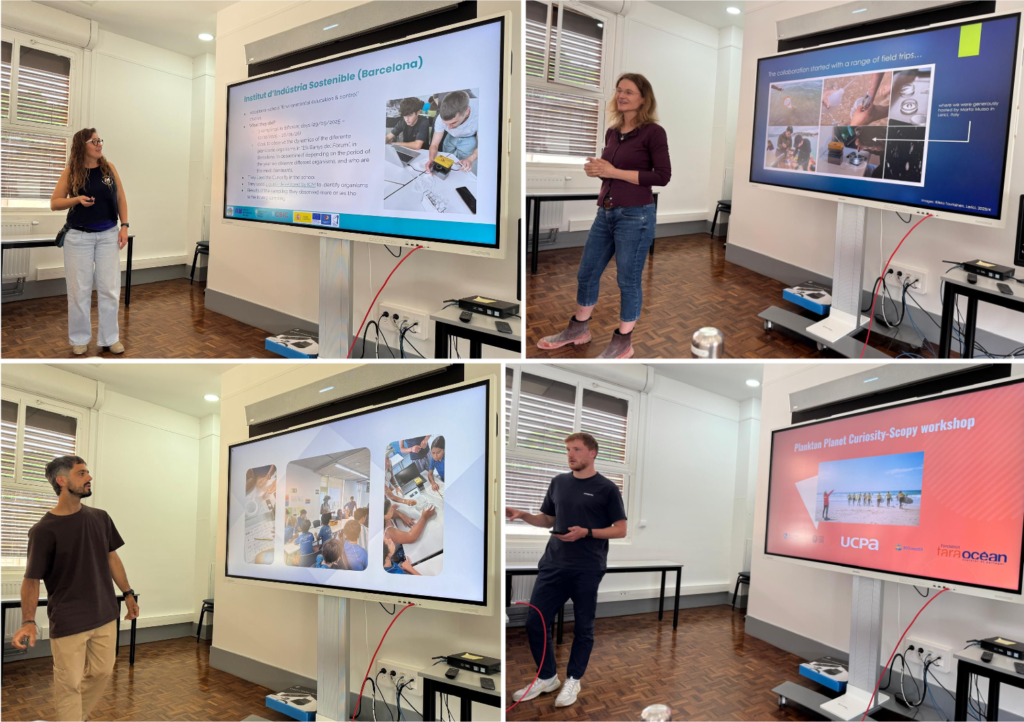 Eli Bonfill Molina (ICM-CSIC) shared the experience of Catalan high schools with the Curiosity microscope, Meike Vogt (ETHZ) showcased how the microscope has been used in science-arts collaborations and workshops, while Santi Merino (IEM Espai de Mar) and Simon Batier (UCPA) presented how the microscope has been integrated into water sports, education and environmental awareness activities. Credit: Noan Le Bescot.
Discussions then focused on the strengths and challenges of plankton literacy activities using the Curiosity microscope across different audiences, including primary and secondary school students and teachers, as well as the general public. Together, participants explored new ideas to maximise the potential of the Curiosity microscope and strengthen engagement with plankton biodiversity.
The group also discussed data sharing and community building around plankton observations, as well as future directions and developments. These discussions included a presentation by Sahima Hamlaoui (Plankton Planet, MNHN) on the Plankton Planet Curiosity iNaturalist platform, which connects users with a global network of plankton taxonomy experts. Participants were also introduced to the Plankton Ecosystems project, led by Riikka Tauriainen (EcoArtLab), a participatory art-science programme that promotes ocean literacy through community science technologies, collaborative art formats and experiential learning about marine ecology and plankton diversity.
The following day, participants took part in hands-on plankton sampling at the Jardin des Plantes and along the Seine River. They then observed and compared the collected samples using Curiosity microscopes, providing a unique opportunity to discover the aquatic biodiversity of Paris while exchanging practical tips and techniques for optimising plankton collection, imaging and observation.
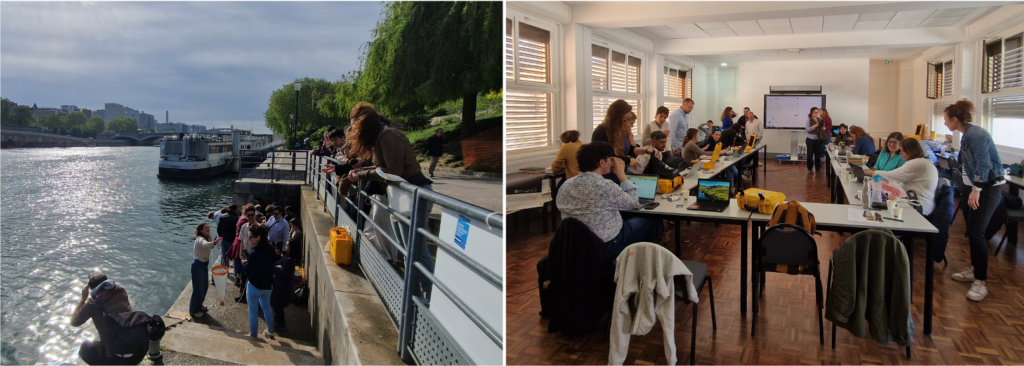 Participants at the workshop took part in plankton sampling at the Jardin des Plantes and along the Seine River, followed by imaging and observation using Curiosity microscopes. Credit: Sahima Hamlaoui.
The workshop concluded with a round-table discussion on ‘Planetary and Citizen-Based Plankton Inventory and Monitoring’, bringing together representatives from the Muséum National d’Histoire Naturelle, Sorbonne University, the Tara Ocean Foundation (FTO) and the International Platform for Ocean Sustainability (IPOS).
The workshop highlighted the importance of bringing together researchers, educators, artists and institutions to share experiences, collectively develop ideas and foster new collaborations. Made possible through the support of the European Commission among others, such initiatives strengthen the connection between science and society and contribute to a collaborative future for plankton biodiversity observation, monitoring and conservation.