The Plankton Planet Curiosity-Scopy workshop, held on 27-28 April 2026 at the Muséum National d’Histoire Naturelle in Paris, brought together recipients from across Europe who had received Curiosity microscopes through BIOcean5D. The workshop provided a unique opportunity for participants to share experiences and showcase how the microscopes have been integrated into a wide range of research, education, public engagement and artistic initiatives.
Following the workshop, we spoke with Eli Bonfill i Molina, member of the EMBIMOS research group at ICM-CSIC and Technical Coordinator of the ProBleu project, which promotes ocean and water literacy in school communities. She shared insights into how the Curiosity microscope initiative has developed in Catalonia (Spain), made possible through the microscopes distributed by BIOcean5D, as well as her key takeaways from the workshop.
Curiosity in Action
“Since the training workshop in Barcelona in July 2025, Curiosity microscopes have been used in six secondary schools in Catalonia,” explains Eli. “Each school has adopted the tool in a slightly different way, but in general it has been used to observe plankton samples collected from the sea, rivers or coastal lagoons, with the images projected for the whole class to observe together.”
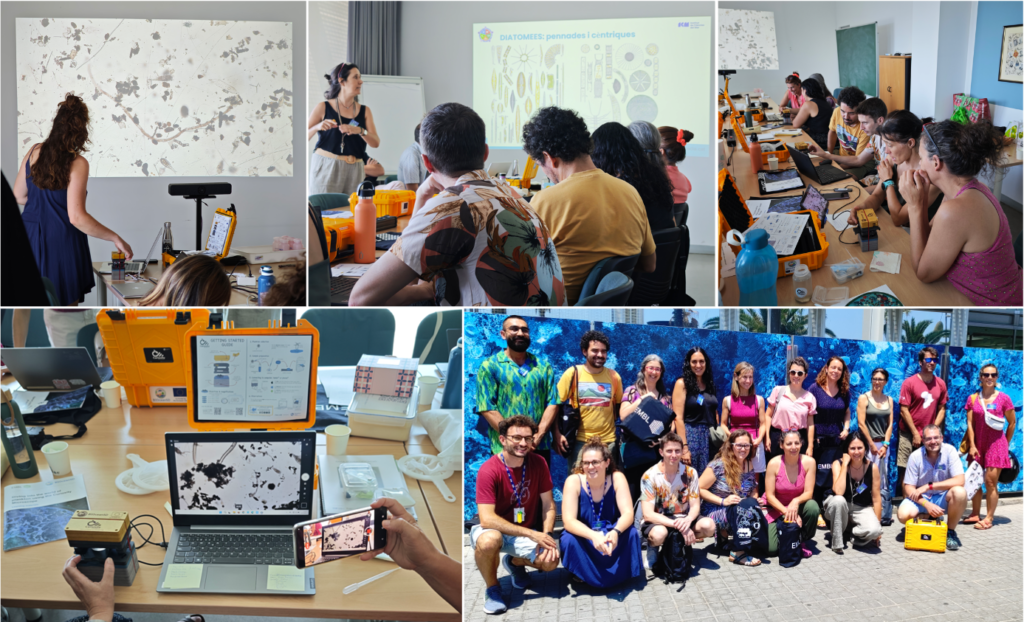 Curiosity microscopes were distributed by BIOcean5D to six schools in Catalonia, with training provided for teachers at a workshop at ICM-CSIC in Barcelona in July 2025. Credit: Efraim Culfa, Noan Le Bescot, Eli Bonfill i Molina.
One school has taken the initiative a step further by incorporating the microscope into a CanSat satellite project. “The BioNautes project explores the ability of extremophilic microorganisms, such as tardigrades or rotifers, to survive the physical conditions experienced during a CanSat launch and descent,” says Eli. “Students used the Curiosity microscope to select the tardigrades sent up aboard the satellite launched in April.”
The microscope has also been used beyond the classroom: a local company near one of the participating schools used the Curiosity microscope during a summer science camp, enabling participants to observe microplankton, with support from expert local researcher Rosa Trobajo (IRTA).
Across each of these initiatives, the ICM-CSIC has played an important supporting role by providing teachers with technical and scientific guidance. The institute has also encouraged participants to upload their observations to the MINKA citizen science platform, a digital observatory that centralises biodiversity and environmental observations, with collaborative identification and expert review.
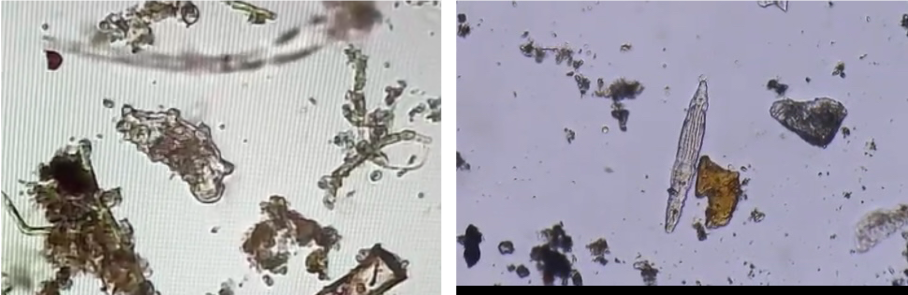 Images of a tardigrade and rotifer, sampled and observed using the Curiosity microscope by students from La Pineda high school, Badalona, with their teacher Bet Vallcorba.
Looking Ahead
Eli is already exploring new ideas for activities using the Curiosity microscope. “I’m hoping to organise a night-time plankton observation workshop in the near future, as well as a plankton illustration workshop. I’d also like to design a challenge for the Catalan network of Blue Schools that encourages students to collect marine plankton samples and upload their images to MINKA as part of the BioMARató, a citizen science BioMarathon dedicated to documenting marine and coastal biodiversity.”
Another ambition is to establish a system through which Curiosity microscopes can be shared among schools in the Catalan network of Blue Schools, maximising their use and allowing even more students to discover the microscopic life of our oceans, rivers and lakes.
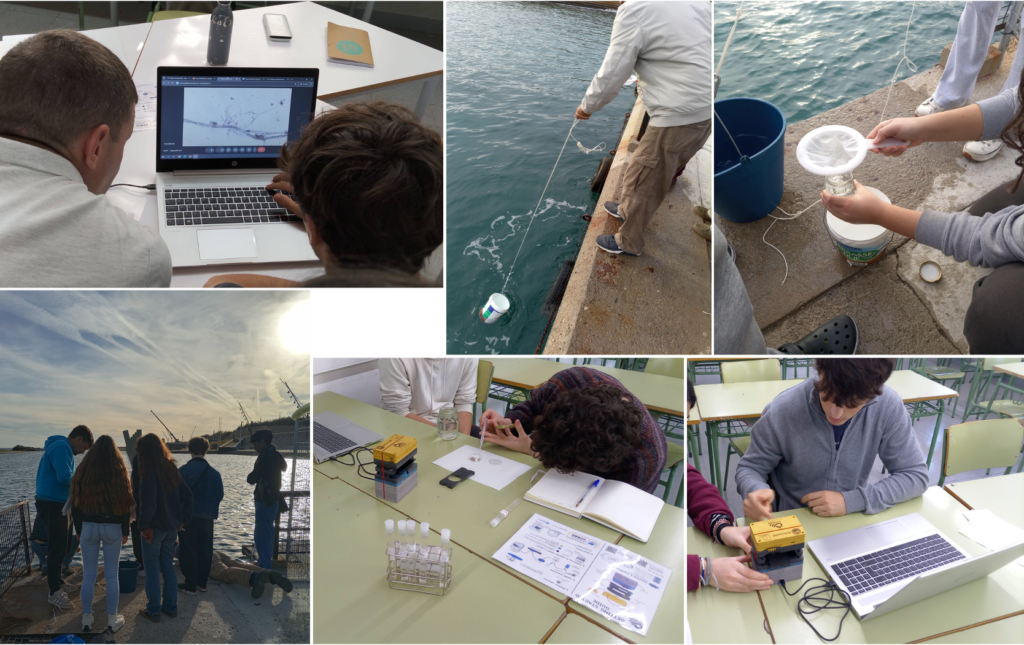 Students from Escola d’Indústria Sostenible, Barcelona, sampling and observing plankton from Els Banys del Fòrum, Barcelona, using the Curiosity microscope distributed by BIOcean5D.
Connecting the Curiosity Network
Eli shared these past, ongoing and future projects and initiatives in Catalonia with other members of the Curiosity network participating at the Plankton Planet Curiosity-Scopy workshop in Paris. “It was fascinating to discover the many different ways the microscope is being used, for example, in artistic projects,” says Eli. “I was particularly interested in some of the initiatives currently taking place in France and would like to explore how similar activities could be implemented in Catalonia. The workshop was also a great opportunity to connect with other partners and the organising team, laying the foundations for future collaborations and the co-creation and development of new projects aimed at raising awareness of plankton biodiversity.”