BIOcean5D is dedicated to the exploration of marine life and how it changes with space, time and human impact. Beyond research, we actively promote skills development and capacity building to train the next generation of scientists and support the integration of FAIR (Findable, Accessible, Interoperable and Reusable) practices in ocean science.
Within this framework, we advance professional skills development through the design and delivery of summer and winter training schools, as well as open science hackathons. In parallel, capacity development is strengthened through a range of accessible online courses.
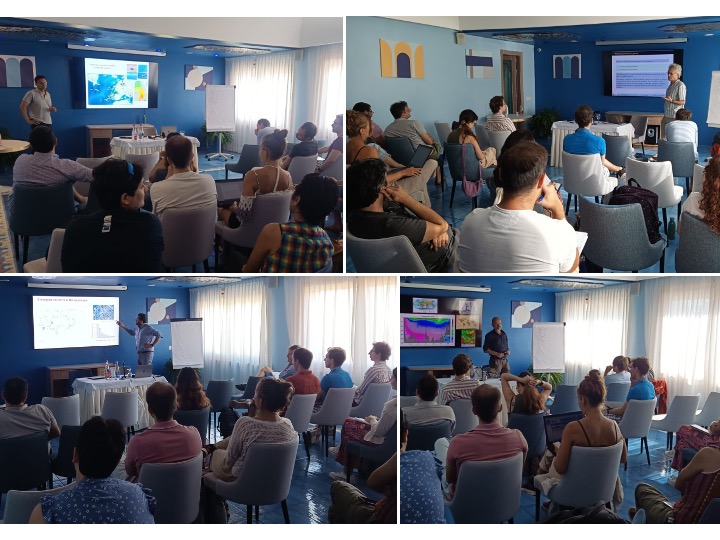 The Synergy Summer School, 24-28 June 2024 in Ischia, focused on ‘Complexity and emergence in marine ecosystems/seascape: theory, mechanisms and data’.
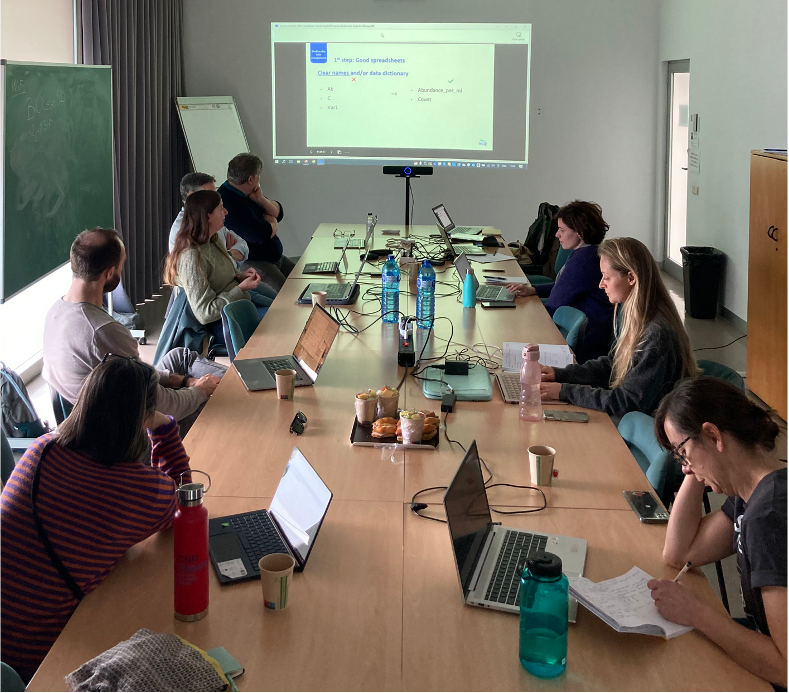 The BIOcean5D Hackathon, 13 February 2025 at the Institut de Ciències del Mar (ICM-CSIC) in Barcelona, provided support to advance FAIR marine biodiversity data. Credit Claudia Delgado.
As part of this effort, three online, self-paced courses – available at no cost to learners – have been developed by the Marine Training Unit (EMBRC, EMBRC-BE/Ghent University) within the framework of BIOcean5D. These initiatives reflect our commitment to innovation in ocean education and training, using digital tools to make learning more accessible and widely available.
These courses are designed for Early Career Researchers (ECRs) and Early Career Ocean Professionals (ECOPs), as well as researchers seeking opportunities to develop their skills, both within BIOcean5D and across the wider marine science community. This work aligns with our core priority of empowering professionals through training, knowledge transfer and lifelong learning in ocean and marine sciences.
Dive into the three courses below!
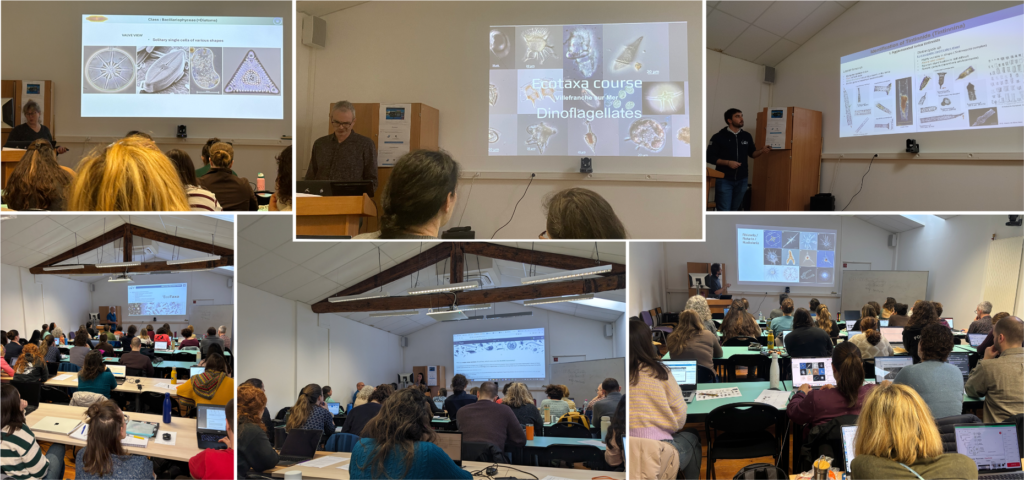 The BIOcean5D course ‘Plankton Taxonomy from Quantitative Imaging Devices (using EcoTaxa)’, 19-23 January 2026 at the Institut de la Mer de Villefranche (Sorbonne Université-CNRS), strengthened plankton taxonomy skills through hands-on training. Credit: Fabien Lombard, Hugo Zaccomer, Savannah Stresser, Myrsini Charikleous.
▶ Research Data Management
This course introduces the essentials of Research Data Management (RDM) for researchers working with complex, interdisciplinary datasets. Designed for both beginners and those looking to strengthen their data practices, the course covers the full data lifecycle – from planning and organising data to storing, sharing and preserving it responsibly.
Drawing on real-world examples from marine and biodiversity research, participants will develop the skills to:
- Understand the value and role of RDM in scientific practice,
- Create a basic Data Management Plan (DMP) using widely adopted tools and templates,
- Apply best practices for data organisation, documentation and storage,
- Navigate ethical, legal and institutional requirements for data handling,
- Prepare data in line with FAIR (Findable, Accessible, Interoperable, Reusable) principles.
With an estimated duration of 10 hours, the course equips participants with both the practical tools and the mindset needed to manage research data more effectively and sustainably.
▶ FAIR Data Principles
This course introduces the concepts and practices of FAIR data management, ensuring that research data are Findable, Accessible, Interoperable and Reusable.
Structured into five modules, the course guides participants through the key steps needed to prepare, document, license and publish data in ways that enhance long-term usability, scientific integrity and cross-disciplinary collaboration.
Combining practical guidance with real-world examples from marine biodiversity, ecology and molecular research, the course empowers participants to make their data both FAIR and impactful.
This course is an ideal follow-up to the Research Data Management course, building on core concepts and advancing towards open and sustainable science.
▶ Science Communication
This short course introduces the core principles and best practices of science communication. It is designed to help researchers communicate their work effectively to both scientific and non-scientific audiences. The course is structured around four main topics, each with defined learning objectives:
Introduction to science communication
- Understand and define science communication,
- Recognise its role in connecting science with society.
What makes good science communication?
- Understand the three core elements: knowing your audience, telling a compelling story and defining clear objectives,
- Recognise the importance of engaging both scientific peers and the general public,
- Identify and profile different audiences to tailor messages effectively,
- Understand the basics of copyright and Creative Commons, and correctly use and acknowledge third-party resources,
- Apply best practices.
Channels of science communication
- Distinguish between different models and approaches,
- Reflect on how these models apply in real-world contexts,
- Identify key communication channels and their characteristics,
- Select and use appropriate channels to maximise effectiveness.
Measuring impact
- Understand why impact assessment is essential,
- Describe the key stages of evaluation,
- Select appropriate tools and methods,
- Effectively report outcomes and impact.